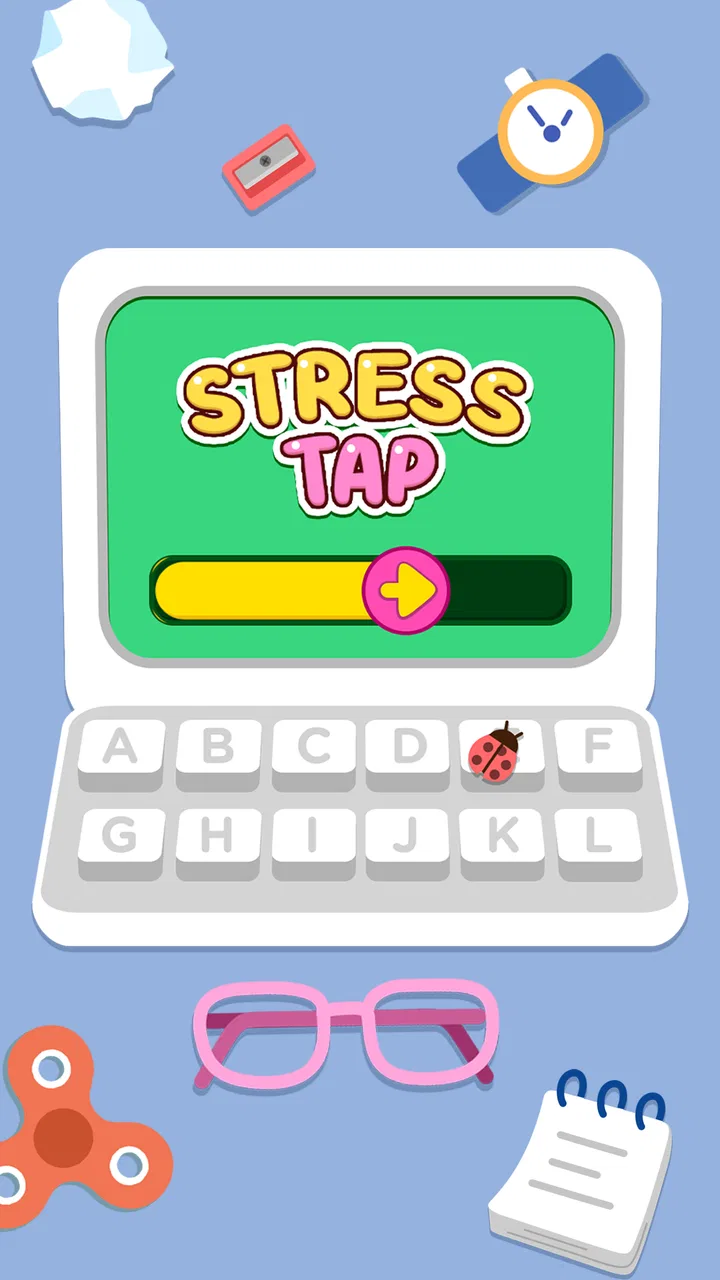
Stress Tap Ease: ASMR Games
- 4.7
- Rating
- 1.00M
- Installs
- Free
- Price

 Analysis by App-foxy
I went into Stress Tap Ease: ASMR Games expecting a small, disposable time-killer and found something more specific: a gentle role-playing puzzle game built around tapping, repetition, and the satisfaction of completing compact challenges. Its appeal is immediate because it asks very little from you. I can open it when I have a few quiet minutes, follow the visual and tactile rhythm, and leave without needing to remember a complicated story or manage a large cast of characters.
That simplicity is also the central question. Many relaxing games feel excellent during the first few sessions, then become background noise once the novelty wears off. I paid particular attention to whether this one could become a useful habit rather than merely a pleasant first impression. My conclusion is mixed but favorable: it works best as a short reset between demanding tasks, while people looking for a deep role-playing adventure or a puzzle game with constantly changing strategy will probably outgrow it.
How the first week feels
The first week is where the game makes its strongest case. The tap-focused design is easy to understand, and the ASMR-inspired presentation gives each interaction a calming purpose. I did not need a long tutorial or a large block of free time before feeling comfortable. That matters for a game aimed at children, adults, and anyone who wants a low-pressure distraction, although its Teen content rating means parents should still check whether its overall tone suits younger players.
You May Also Like

 Blood Strike: 2.5 Anniversary
Blood Strike’s Loadouts Turn Every Drop Into a Tactical Gamble
A close look at Blood Strike’s custom loadouts: how fast access to signature weapons reshapes its battle royale rhythm, rewards preparation, and narrows the gap between fights.

 Pandora - Music & Podcasts
Pandora’s Music Is Easy to Start, but Harder to Recover
Pandora’s strength is its low-effort path from a seed to a station. Its weak spot is how much confidence it asks you to place in connection, setup, and quiet recovery.

 8 Ball Pool
 Is Built on Rivalries, Rematches, and Routine
A close look at the rivalries, rematches, shared routines, and unanswered safety questions that turn a quick pool match into a persistent mobile community.

 Samsung Music
’s Quiet Strength Is Playing What You Already Own
Its reach comes less from spectacle than from dependable access to a personal library. That simplicity is both the app’s strongest retention engine and its ceiling.

 AccuWeather: Weather Radar
AccuWeather Review: A Quick, Clear Forecast for Everyday Decisions
For everyday plans, the best forecast is the one you can understand quickly. AccuWeather makes rain timing, radar, and local conditions easy to act on, with a few trade-offs.

 Hill Climb Racing
Why Hill Climb Racing Still Turns Crashes Into One More Run
A tiny car, a bumpy hill and one more upgrade: Hill Climb Racing keeps resurfacing because its simple chaos makes every near-miss feel personal.
More From Our News Desk



What I liked most at the beginning was the lack of mental overhead. Traditional role-playing games often ask me to compare equipment, follow quests, learn several systems, and keep track of long-term goals. Here, the experience is much closer to a guided decompression ritual. I can focus on the next small action instead of worrying about an elaborate build. That makes it particularly suitable after work, during a commute break, or before bed when I want interaction without a demanding challenge.
The puzzle element gives the tapping a little more purpose than simply pressing the screen repeatedly. I found myself watching for patterns and adjusting my timing rather than treating every moment as automatic. This is an important distinction: the game is relaxing, but it is not necessarily passive. If I rush, the calming quality can disappear and the activity starts to feel like a chore. My best sessions came when I treated each puzzle as a short concentration exercise rather than trying to clear everything as quickly as possible.
There is also a useful emotional contrast between ordinary mobile games and this one. Competitive titles often encourage me to chase a score, protect a streak, or outperform another player. That can be motivating, but it is not always what I need. This game gives me a softer reason to continue: the pleasure of completing a small interaction cleanly. For someone who becomes tense when a game punishes mistakes or pushes constant urgency, that difference may be more valuable than a larger feature list.
A practical routine for short sessions
I found a simple routine that makes the opening experience better. I start with a clear stopping point, play for one or two puzzle cycles, and avoid treating the session as an obligation. That prevents the soothing rhythm from turning into mindless scrolling. It also helps reveal whether the game is genuinely helping me reset or whether I am continuing only because the next tap is available.
Another useful approach is to play it between two activities rather than at the end of an endless entertainment session. For example, after finishing email but before starting dinner, a brief round can provide a clean mental boundary. The game is well suited to that transition because it does not require me to remember a complicated plot or return to a high-stakes battle. I can put it down with little friction.
The trade-off is that this same accessibility limits the sense of discovery. During the first week, the novelty of the presentation and the satisfaction of the tap-and-puzzle loop carry much of the experience. Players who want a strong narrative, character relationships, or a world that unfolds through exploration should not mistake the role-playing label for the scale of a traditional RPG. This is a compact, calming interpretation of the category, not a replacement for a larger adventure.
What the game is really asking from you
Although the store summary presents it as an ASMR puzzle experience, I think its real test is whether you enjoy repetition with light attention. The game rewards being present for small actions, not mastering a complex system. That makes it a reasonable choice for a child who enjoys tactile puzzle play, an adult who needs a quiet pause, or a casual player who does not want to invest in a long campaign.
It is less convincing for anyone who needs a strong sense of progression. If your favorite mobile RPG is built around planning a team, unlocking major abilities, or making decisions that reshape the story, the early charm may not be enough. I would also skip it if you dislike tap-heavy interactions in general. The ASMR angle changes the mood of tapping, but it does not change the basic fact that tapping remains the main way you engage with the game.
Whether it has value after the novelty fades
After the first month, the question becomes less about whether the game is pleasant and more about whether it earns a regular place on the phone. In my experience, its recurring value depends heavily on how I define a useful game session. If I want a reliable five-minute reset, it has a clear role. If I expect new strategic layers each time I return, it feels thinner.
The strongest long-term use is as a mood-based tool. I can imagine opening it when I am mentally tired but still want to do something interactive. Unlike a video, it asks me to participate, yet unlike a demanding puzzle title, it does not require sustained analytical effort. That middle ground is uncommon enough to be worthwhile. It can fill the gap between doing nothing and starting a game that consumes an entire evening.
Its role-playing structure also gives the tapping a little more context than a completely abstract relaxation toy. Still, I would not rely on that label alone when deciding whether to install it. The important question is whether its particular blend of light progression, puzzles, and soothing interaction matches your habits. For me, it works when I approach it as a small ritual. It works less well when I expect a substantial destination.
The audience response suggests that this narrow purpose is connecting with people. The game holds a 4.5 average from around 2.1 thousand ratings, and it has passed one million installs. Those figures do not make it automatically suitable for everyone, but they do indicate that the basic concept has found a meaningful audience. I would interpret that popularity as evidence of accessible appeal, not as proof that the game offers endless variety.
Maintenance and the effort of keeping it useful
The maintenance burden is low in one sense: I do not need to study a guide, memorize a complicated build, or schedule long sessions to get value from it. That makes returning easy. I can leave it alone for several days and come back without feeling lost. For casual players, that is a genuine strength because the game does not punish an inconsistent routine through a demanding knowledge gap.
There is another kind of maintenance, though, and it comes from managing my own expectations. To keep the experience relaxing, I have to resist turning every available tap into a target. If I play while distracted by notifications or hurry through the interactions, the atmosphere becomes less effective. The game cannot create calm by itself; it provides a framework that works better when I give it a small amount of attention.
I also recommend deciding in advance whether optional purchases fit your budget. The game is free to start, with in-app purchases priced at $1.99 per item. That is not an automatic problem, but small purchases can feel more tempting in a game built around frequent, satisfying interactions. I would play the free experience first and only pay for something if it clearly improves the way I personally use the game. Anyone wanting a completely purchase-free environment should be cautious about installing a title with optional items.
For families, the Teen rating deserves a practical check rather than an assumption that a calming presentation makes the game suitable for every child. The store summary specifically mentions children and adults, but age suitability is still a household decision. I would look at the game together with a younger player, discuss purchases before handing over the device, and make sure the tapping loop is not replacing sleep, homework, or outdoor activity.
Where fatigue begins
The main source of fatigue is repetition without enough personal variation. At first, repeating a satisfying action feels therapeutic. Later, the same action can feel predictable if I am not using it for a specific purpose. This is why I see the game as a maintenance-friendly habit rather than a game I would play continuously for long stretches. Its best sessions have a beginning and an end.
Another possible weakness is the limited fit for players who need escalating difficulty. Relaxation and challenge can coexist, but they pull in different directions. If the puzzles become too comfortable, a puzzle specialist may lose interest. If I force myself to play faster or chase completion, I risk losing the calm atmosphere that makes the game distinctive. The right balance is personal, and the game will not satisfy both extremes equally well.
The tapping itself may also become tiring for some users. Even when the interaction is simple, repeated screen gestures can feel monotonous or physically uncomfortable over time. I would keep sessions short and take a break if my hand or wrist starts to feel strained. That is not a criticism of a particular feature so much as a reminder that the game’s core mechanic should be enjoyed in moderation.
Version 4.0 gives the current experience a clear point of reference, and the game supports devices running Android 8.0 or later. That makes it approachable for many Android users, though anyone with an older phone should check compatibility before planning around it. I would also keep expectations realistic about updates: a version number alone does not guarantee that the game will keep feeling fresh month after month. Long-term value still depends on whether the existing loop remains enjoyable for you.
When another kind of game is better
If I want a serious puzzle workout, I would choose a title designed around layered logic, experimentation, and increasingly difficult solutions. If I want an absorbing role-playing story, I would choose a game with deeper character development and more substantial exploration. If I want social competition, I would look for multiplayer challenges or leaderboards. Stress Tap Ease occupies none of those spaces completely, and that is fine as long as I judge it by its actual purpose.
It is a better alternative to those games when my priority is a controlled, low-pressure pause. I do not always want to be challenged, rewarded, or entertained at maximum intensity. Sometimes I want a small activity that helps me shift attention without creating another demand. In that situation, the combination of tapping and light puzzles is more appropriate than a conventional RPG or a competitive puzzle app.
A less obvious comparison is with non-game relaxation tools. A meditation app may be better if I want guided breathing or structured mindfulness. Music may be better if I do not want screen interaction at all. This game sits between those options: it gives my hands something to do while keeping the mental load modest. That makes it useful for restless moments, but not necessarily for someone seeking complete sensory rest.
My long-term verdict
I would recommend Stress Tap Ease: ASMR Games to a friend who wants a free, approachable mobile game for brief calming sessions. Piggy Panda Inc has chosen a focused idea rather than trying to imitate a large console-style RPG, and that focus is the reason the game can fit into ordinary routines. I can use it after a stressful task, during a short waiting period, or whenever I want gentle interaction without a complicated commitment.
I would not recommend it as a sole long-term game for someone who needs constant novelty, deep strategy, or a rich narrative. Once the first-week appeal settles, the game survives on habit and mood rather than dramatic progression. That is a legitimate kind of value, but it is narrower than the broad promise suggested by the role-playing category.
My most honest advice is to treat it like a small daily tool, not an endless destination. Try it free, keep sessions deliberately short, and notice whether the tapping leaves you calmer or simply keeps you occupied. If it becomes a pleasant transition between tasks, it has earned space on your device. If the repetition starts feeling automatic, there is no reason to force a long-term relationship with it.
The lasting strength here is controlled simplicity: the game is easy to enter, easy to leave, and potentially useful when a demanding alternative would be too much. Its weakness is the same simplicity, because players who need expanding systems may run out of reasons to return. For the right person, that balance is not a flaw. It is exactly what makes this modest ASMR puzzle RPG worth keeping around.
FAQs for Stress Tap Ease: ASMR Games
01What is Stress Tap Ease: ASMR Games?
Stress Tap Ease: ASMR Games is a mobile app designed to help users relax and unwind through interactive ASMR experiences. It combines soothing sounds with simple, engaging gameplay to create a calming environment. The app is available for both Android and iOS, offering a variety of mini-games and soundscapes tailored to reduce stress.
02How does Stress Tap Ease help in reducing stress?
The app uses ASMR (Autonomous Sensory Meridian Response) techniques, which are known to induce relaxation and reduce anxiety. By engaging users with gentle sounds and visuals, the app creates an immersive experience that helps shift focus away from stressors. The mini-games require minimal effort, allowing the mind to relax and enjoy the moment.
03Is Stress Tap Ease suitable for all ages?
Yes, Stress Tap Ease is designed to be family-friendly and suitable for users of all ages. The app features simple, non-violent games and calming soundscapes that can appeal to both children and adults. However, parental guidance is recommended to ensure the content is appropriate for younger children, as individual sensitivities to ASMR can vary.
04Are there any in-app purchases or ads?
Stress Tap Ease offers a freemium model, meaning it is free to download and play, but includes optional in-app purchases. These purchases can unlock additional content or remove ads for a more seamless experience. The app does include ads, but they are minimal and designed not to disrupt the calming ambiance.
05What devices are compatible with Stress Tap Ease?
Stress Tap Ease is compatible with most modern Android and iOS devices. It requires Android version 5.0 or higher and iOS version 11.0 or later. The app is optimized for both smartphones and tablets, ensuring a smooth and enjoyable experience across different screen sizes and resolutions.
Pros
- Relaxing ASMR sounds enhance user experience.
- Simple interface makes it easy to navigate.
- Wide range of mini-games to reduce stress.
- Customizable settings for personalized play.
- No intrusive ads interrupting gameplay.
Cons
- Limited offline functionality affects accessibility.
- Some mini-games can feel repetitive.
- In-app purchases for full feature access.
- Requires regular updates for optimal performance.
- Occasional lag on older devices.

Stress Tap Ease: ASMR Games
Gallery